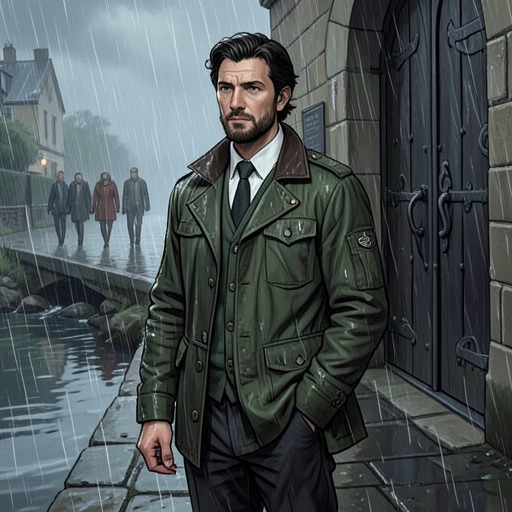
Donie’s assault by the Garavogue
Dark Lies the IslandDonie’s assault by the Garavogue marks a sharp break in an otherwise carefully ordered day: a stranger’s coercion in public leaves Donie frightened, unable to follow his routines, and pursued by the encounter in memory as he travels home. The scene makes the gap between visible commotion and recognized danger consequential: people nearby see what they take to be a fight, but no one comes to help.
The Encounter Beside the River
Donie has finished his biscuits when a stranger sits beside him and addresses him. Donie is already aware of the man’s attention, but the encounter becomes threatening when the man clamps a hand over Donie’s and holds it to the bench. Donie tells him to stop; the man laughs. The control of Donie’s hand turns an ordinary public interaction into a situation in which Donie cannot simply leave.
The stranger’s manner remains unsettlingly casual even as he intimidates Donie. Donie eventually wrenches free and rises, but the man follows alongside him, touches his lower back, and whispers threats. Donie’s attempt to leave therefore does not end the encounter. The man’s proximity and continued contact keep the danger immediate, while Donie’s loud response becomes a means of resisting the words he cannot otherwise shut out.
The Fall and Its Witnesses
The attack culminates when the man abruptly removes his hand, shoves Donie in the lower back, and trips him. Donie falls onto the riverside pathway. Other people are present, but none steps forward; Donie understands that they interpret the scene as a fight between men. Their inaction leaves him alone with the assailant at the moment when help might have altered the encounter.
The man leans over Donie, calls him “Hyena,” and walks away. The insult returns the word Donie had used to describe the stranger, turning Donie’s own attempt to name the threat into the assailant’s final taunt. The exchange does not resolve the confrontation or restore Donie’s sense of control: the stranger can leave, while Donie must carry the encounter away from the river.
The Journey Home
After the assault, Donie’s familiar habits fall away. In Sligo, he does not pause to look at the mountaineering equipment that usually invites him to imagine snowy peaks, greet the wood carver, or count paving slabs on his shortcut through the arcade. These are not new dangers but ordinary landmarks and diversions that had structured his day; now he passes them without engaging with them.
The disruption continues on the train. Donie misses the departure, the stations along the route, and his usual exchange with the inspector. The repeated thought of the assailant and the word “hyena” interrupts his attention across the journey, replacing the day’s ordinary observations and private daydreams. Even after reaching Boyle, he bypasses a kind man who notices his distress and goes directly home instead of making his customary stop for doughnuts at Supervalu.
At home, Donie hurries along the row of houses, but arrival does not immediately end his distress. The sun has come out, and the glare makes him squint; the feeling persists until the door opens and his mother steps outside at the moment he reaches it. The scene closes on this encounter with her, presenting home and maternal presence as the point at which the assault’s immediate hold may begin to ease, without claiming that its effects are resolved.
Narrative Significance
The assault’s aftermath is measured through interrupted routine rather than through a general declaration of harm. The mountaineering shop, the arcade, the train, the inspector, and the planned purchase of doughnuts all show what Donie ordinarily attends to; their omission makes visible how thoroughly the encounter has displaced his customary way of moving through the day. Familiar places remain familiar, but Donie cannot inhabit them as he usually does.
The scene also sets the assailant’s direct intimidation against the bystanders’ misreading of events. Donie recognizes the man’s behavior as threatening, while the people around them apparently see only a fight and leave him unaided. That contrast gives the public setting a double character: it offers witnesses, yet their presence does not become protection. The journey home carries that failure of recognition forward, as the encounter continues to shape what Donie can notice, where he goes, and whom he can bring himself to address.